Is All-on-4 the Right Option for You? 5 Factors to Consider
All-on-4 is the right answer for a lot of people who've lost most of their teeth — but not everyone, and not always. Here are the five things that actually decide it.


Written and medically reviewed by Dr. Sam Jain, DMD, MS, and Dr. Arpana Gupta, DDS, MDS
Published · Updated
The Short Version: When All-on-4 Is the Right Call
All-on-4 tends to be the best option when you're missing most or all of the teeth in a jaw — or you're headed there with loose, failing, or badly decayed teeth — and you want a fixed set of teeth you don't take out at night. Four implants carrying one screwed-in bridge is usually the most efficient way to get there: fewer implants than the old full-mouth approach, often no bone grafting, and a real bite back in days rather than a lifetime of denture adhesive.
It's not the right call for everyone, though. If you're only missing a few teeth in an otherwise healthy arch, replacing them individually or with a smaller bridge is usually the better, more conservative choice — see multiple dental implants. And a handful of jaws genuinely need more support than four implants can give, which is a plan question, not a disqualification. The honest way to decide is to run your own situation through five factors. A surgeon confirms the details on a 3D scan, but you can get a strong sense of where you land just by reading through them.
Factor 1: How Much Bone You Have — and Where
Bone is the factor people worry about most, and it's also the one where they're most often wrong. All-on-4 was designed to work with less bone than traditional implants, because two of the four implants are placed at an angle to reach the denser bone that's still there toward the front of the jaw. That's why so many patients who were told elsewhere they "don't have enough bone for implants" turn out to be candidates after a proper scan. It's a common and welcome surprise.
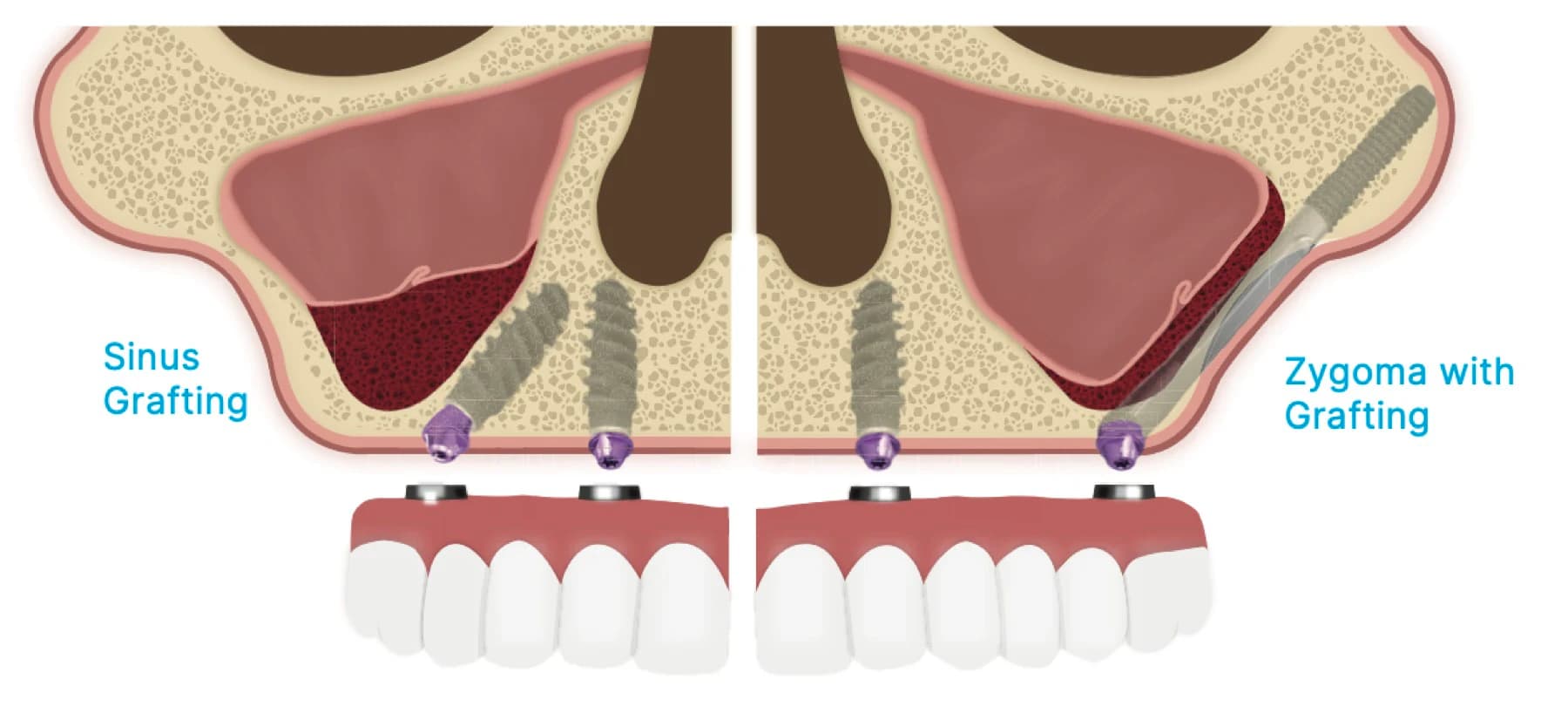
That said, bone quantity and quality both matter, and the upper jaw is trickier than the lower because the sinuses sit right above it. When there truly isn't enough bone for four standard implants to anchor, the answer isn't a denture — it's a different plan: zygomatic implants that anchor in the cheekbone for severe upper-jaw loss, a sinus lift, or targeted bone grafting. The only way to know which bucket you're in is a 3D CBCT scan that measures your actual bone, not a flat X-ray or a guess. That scan is part of the free consultation here — a $499 value at no cost — and it's the single most useful thing you can do to answer this question.
Factor 2: The State of Your Remaining Teeth
All-on-4 replaces a whole arch, so it makes the most sense when the teeth in that arch are mostly gone or not worth saving. If you have several teeth that are loose from gum disease, cracked, heavily decayed, or holding up a failing bridge, the math often favors starting fresh: any hopeless teeth come out, the four implants go in, and a fixed arch goes on — sometimes the same day. Our extraction and immediate implant approach is built for exactly this situation, so you're not left toothless during healing.
If most of your teeth are healthy and only a few are missing, All-on-4 is usually overkill — you'd be removing sound teeth to do it, which is rarely the right trade. This is a real fork in the decision, and it's worth being honest about which side you're on. If you're not sure, our candidacy page walks through how we weigh saving teeth against replacing an arch, and a consultation settles it quickly.
Factor 3: Your Bite, and How Hard You Chew
Here's a factor most articles skip: the force of your bite. Everything on an All-on-4 arch rides on four implants, so how those four supports are placed and how much load they'll carry is central to whether the plan holds up for decades. People who clench, grind, or have a heavy bite put more stress on the bridge and the implants underneath it. Sometimes four is plenty; sometimes the smarter engineering call is more support.
This is where planning by an actual engineer matters. Dr. Sam Jain holds an MS in mechanical engineering alongside his dental degree, and he plans every case around how bite force spreads across the arch, not a one-size template. For heavier bites or generous bone, that can mean stepping up to the All-on-8 Robust protocol he developed — more implants for a sturdier foundation. The point isn't that more is always better; it's that the right number is the number your particular jaw and bite need, and that's a judgment call a surgeon makes after seeing your scan.

Factor 4: Your Overall Health and Habits
Implants heal by fusing to bone, so anything that slows healing is worth an honest conversation before you commit. Uncontrolled diabetes, active gum infection, and heavy smoking all raise the risk of trouble — smoking in particular restricts blood flow to the healing site. None of these is an automatic no. Usually it means we stabilize the issue first: get blood sugar under control, treat the gum infection, cut back or quit smoking around the surgery. Your surgeon will give you a realistic picture based on your health history, not a scary blanket rule.
Anxiety about the surgery itself is its own kind of health factor, and a common one. It shouldn't be the thing that keeps you from fixed teeth. IV sedation is available in-house, so most of the appointment passes without your really being aware of it. Because the same two surgeons plan, place, and restore your case — no fly-in surgeon who places implants and hands you off — there's one team accountable for how you heal, which matters most when a case is medically complicated.
Factor 5: What You Actually Want — and What It Costs
The last factor is you. All-on-4 is the right option when your goal is fixed, non-removable teeth that let you eat normally, taste your food, and stop thinking about your mouth — and when you're ready for surgery to get there. If a removable denture genuinely suits your life and budget, that's a legitimate choice too; our implants vs. dentures comparison lays out the honest trade-offs so you're choosing, not defaulting.
Cost is part of wanting it, so we'll be direct. All-on-4 here is one fixed, all-included per-arch fee — extractions, any grafting, IV sedation, and your choice of final material are inside it — and an arch that needs six or eight implants comes as an itemized written quote after the free consultation and 3D scan. Roughly 92% of our full-arch patients finance the treatment — often in the range of a monthly car payment — through options like Cherry and CareCredit. We're also in-network with many PPO plans. The full breakdown is on our dental implant cost page. One more thing that shapes the decision for a lot of people: because planning, guided surgery, IV sedation, and an in-house zirconia mill all sit under one roof, we deliver final custom-milled teeth in about 72 hours for a full arch, not six to eight months of temporary plastic. If a fast, finished result matters to you, that's a real point in All-on-4's favor — see same-day dental implants.
Written and medically reviewed by Dr. Sam Jain, DMD, MS, and Dr. Arpana Gupta, DDS, MDS, who own this practice.
This article is patient education, reviewed by Dr. Sam Jain, DMD, MS, and Dr. Arpana Gupta, DDS, MDS, and is not a substitute for an exam. Treatment recommendations are made only after an in-person consultation and 3D imaging.